
Search Delaware Unclaimed Money
Delaware holds millions of dollars in unclaimed money on behalf of residents who have lost track of old accounts, uncashed checks, forgotten stock dividends, and other financial assets. The state's Office of Unclaimed Property maintains a free online database where anyone can search by name and file a claim at no cost. Over $1.7 billion has been returned to rightful owners in the last four years. This page covers how to find unclaimed money in Delaware, where else to look beyond the state portal, and how the claims process works from start to finish.
Delaware Unclaimed Money at a Glance
How to Search Delaware Unclaimed Money
The first place to look is the Delaware Office of Unclaimed Property portal. This is the official state database maintained by the State Escheator, Brenda R. Mayrack, who also serves as Director of the Office of Unclaimed Property. The search is free and open to anyone. You do not need an account. Results tell you whether property is available to claim. The portal is updated on a regular schedule and reflects the most current inventory of unclaimed funds held by Delaware.
Not every property type appears in the standard search results. Gift cards, gift certificates, bonds, and money orders require a different path. If you believe you have unclaimed money but cannot find your name in the database, the state offers an Online Request Form. Submit it through the portal, and the office will research whether matching property exists. You may also receive a direct outreach letter from the office if they have already identified property in your name.
The state does not show property values online. This is a fraud prevention measure required by statute. The amount and type of your unclaimed property is only shared after you prove a legal right to it. You will learn the value once your claim is reviewed and your identity is confirmed.
unclaimedproperty.delaware.gov is the official starting point for any unclaimed money search in Delaware. It is worth checking even if you have never lived in the state, since Delaware incorporates a large share of U.S. businesses and may hold funds from companies that operated across state lines.
The Delaware Office of Unclaimed Property portal is the official state database where you can search and file claims online at no cost, with results based on the most current reporting from holders across all three Delaware counties.
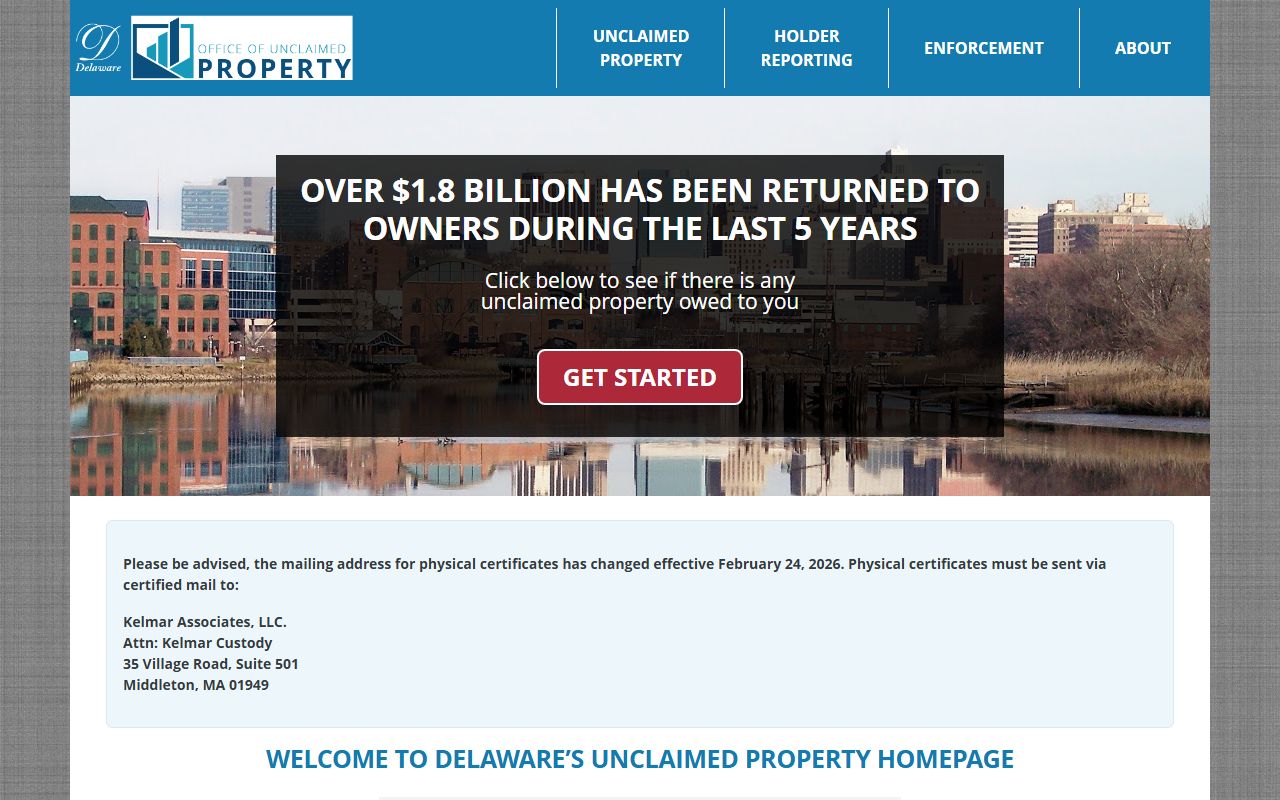
The portal shows property by owner name but hides the value until your identity is confirmed. It covers funds remitted from New Castle, Kent, and Sussex counties as well as from Delaware-chartered businesses nationwide.
What Counts as Unclaimed Money in Delaware
Delaware's unclaimed property program covers a wide range of financial assets. Common types include checking and savings accounts, uncashed wage and payroll checks, uncashed stock dividends, stock certificates, insurance payments, utility deposits, customer deposits, accounts payable, credit balances, and refund checks. Money orders, traveler's checks, mineral proceeds, court deposits, uncashed death benefit checks, unused gift cards, and life insurance proceeds also qualify.
Under Delaware Code § 1130, property is broadly defined to include money, virtual currency, interest, dividends, checks, drafts, deposits, credit balances, customer overpayments, stored-value cards, refunds, credit memorandums, unpaid wages, unused tickets, pari-mutuel tickets, mineral proceeds, and unidentified remittances. Securities, bonds, debentures, and notes also fall under this definition. Real estate and vehicles are excluded. Those fall under different state programs.
Unclaimed property laws in the United States began as a consumer protection measure. They have grown to cover not just original owners but heirs and estates as well. Once the state takes custody, it holds the property indefinitely. There is no time limit on when you can come forward and claim what belongs to you.
The What Is Unclaimed Property page on the state portal explains all the financial instruments that can become dormant and be turned over to the state, helping you know what to search for and where those funds might have originated.
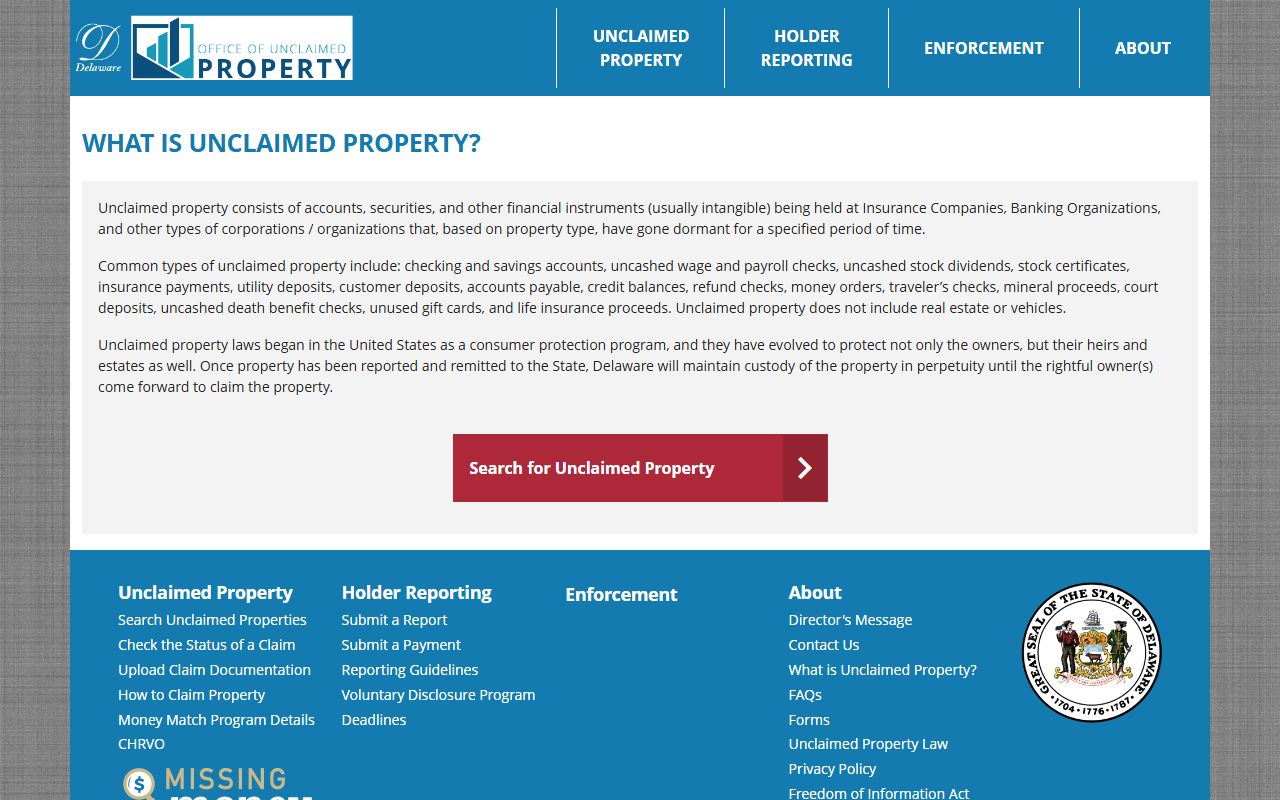
Former employers, banks, utility companies, insurance carriers, and investment firms are the most common sources of unclaimed money in Delaware. If you have ever moved, changed jobs, or held accounts you stopped using, it is worth running a search.
Delaware Unclaimed Money Laws
The legal framework for unclaimed money in Delaware is Title 12, Chapter 11 of the Delaware Code. This chapter covers everything from how property is defined to how dormancy periods are calculated to how claims are processed and appealed. Delaware is among the most significant states nationally for unclaimed property, partly because so many U.S. corporations are chartered here.
Section 1133 sets the dormancy periods. A traveler's check goes dormant 15 years after issuance. A money order goes dormant 5 years after issuance. Demand, savings, and time deposits go dormant 5 years after maturity or after the last indication of owner interest, whichever comes first. Wages and commissions become dormant 5 years after the amount was payable. Securities go dormant after 3 years without owner activity. Stored-value cards and gift cards go dormant 5 years after the last use, balance verification, or addition of funds.
Once the state takes custody, interest stops. Under § 1154, no person is entitled to receive interest on unclaimed property from the date a report is made to the State Escheator. This applies regardless of whether interest was accruing before that point. It is one of the key limitations claimants should know before filing.
If your claim is denied, § 1167 gives you 120 days from the notice date to apply for a hearing before the Tax Appeal Board. A ruling from that board can be further appealed to the Delaware Court of Chancery. The process has multiple steps, but the state sends written notice of every determination and the appeals path is clearly defined.
Note: Delaware is a pay-to-current state under 12 Del. C. § 1135, meaning holders must remit the current value of the property at the time of reporting, not a reduced or historical figure.
Delaware Code Title 12, Chapter 11 is the complete statute governing unclaimed money in the state, setting dormancy periods, reporting deadlines, and the full process for how owners and heirs can recover property held by the state.
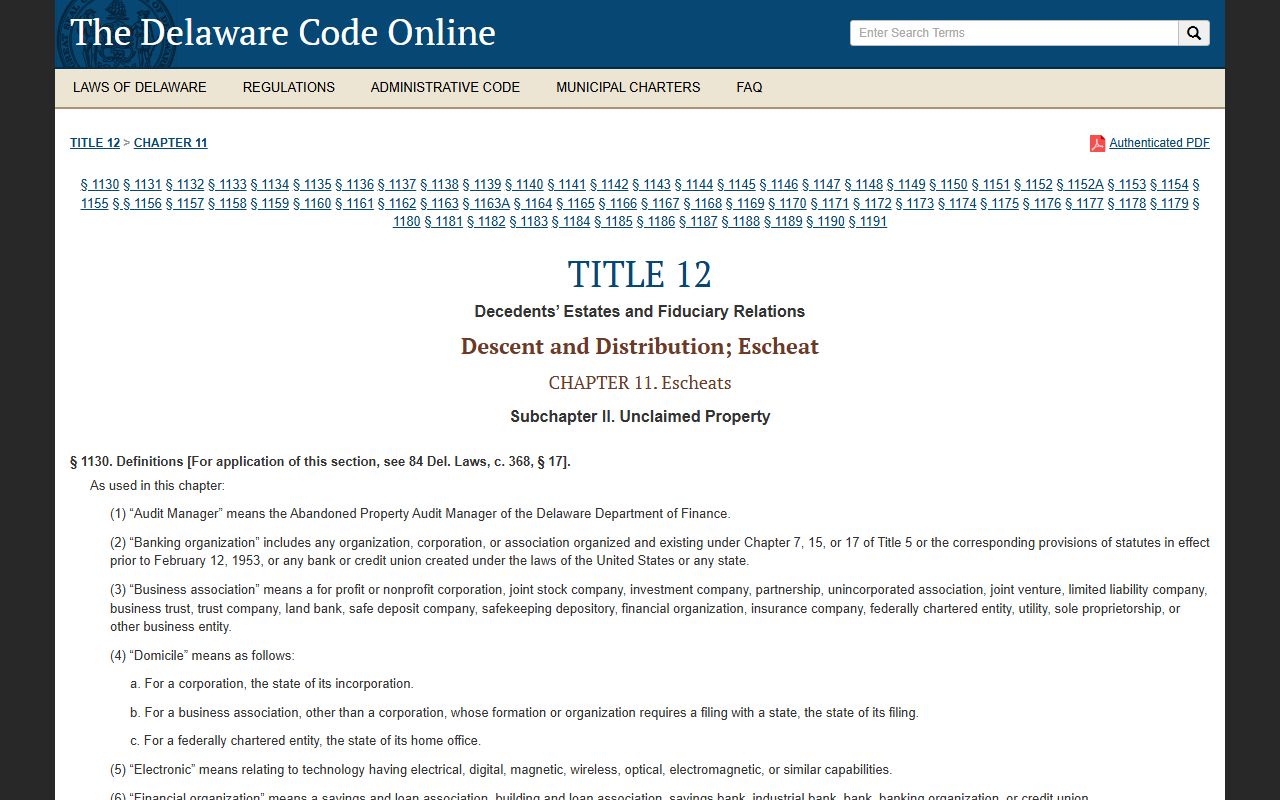
These statutes apply to all holders of unclaimed property in Delaware, from banks and insurance companies to employers and utilities. Any business operating in Delaware or holding funds belonging to Delaware residents is subject to these requirements.
How to Claim Unclaimed Money in Delaware
Filing a claim is free. The state charges no service fees at any point in the process. You can file at any time. There is no deadline. The state holds property until the rightful owner or their heirs come forward, whether that takes one year or several decades.
Start by searching the database at unclaimedproperty.delaware.gov. If you find your name, begin the online claims process from the same portal. You will need to provide proof of identity and documentation showing your legal right to the property. The level of documentation varies by property type and the amount involved. Heirs and estate representatives need additional paperwork to prove entitlement.
As a fraud prevention measure, the state does not send funds by wire or ACH. All payments go out by check through United States Postal Service first-class mail or by courier to the address you provide during the claim. If you receive proceeds from liquidated securities, you may receive an IRS Form 1099-B. Dividends of $10 or more generate a Form 1099-DIV. Plan for the tax implications before filing your claim.
The Delaware Office of Unclaimed Property FAQ for Claimants answers the most common questions about the claims process, including what documents to gather, what to do when property is not found in the main database, and how to handle claims on behalf of a deceased relative.
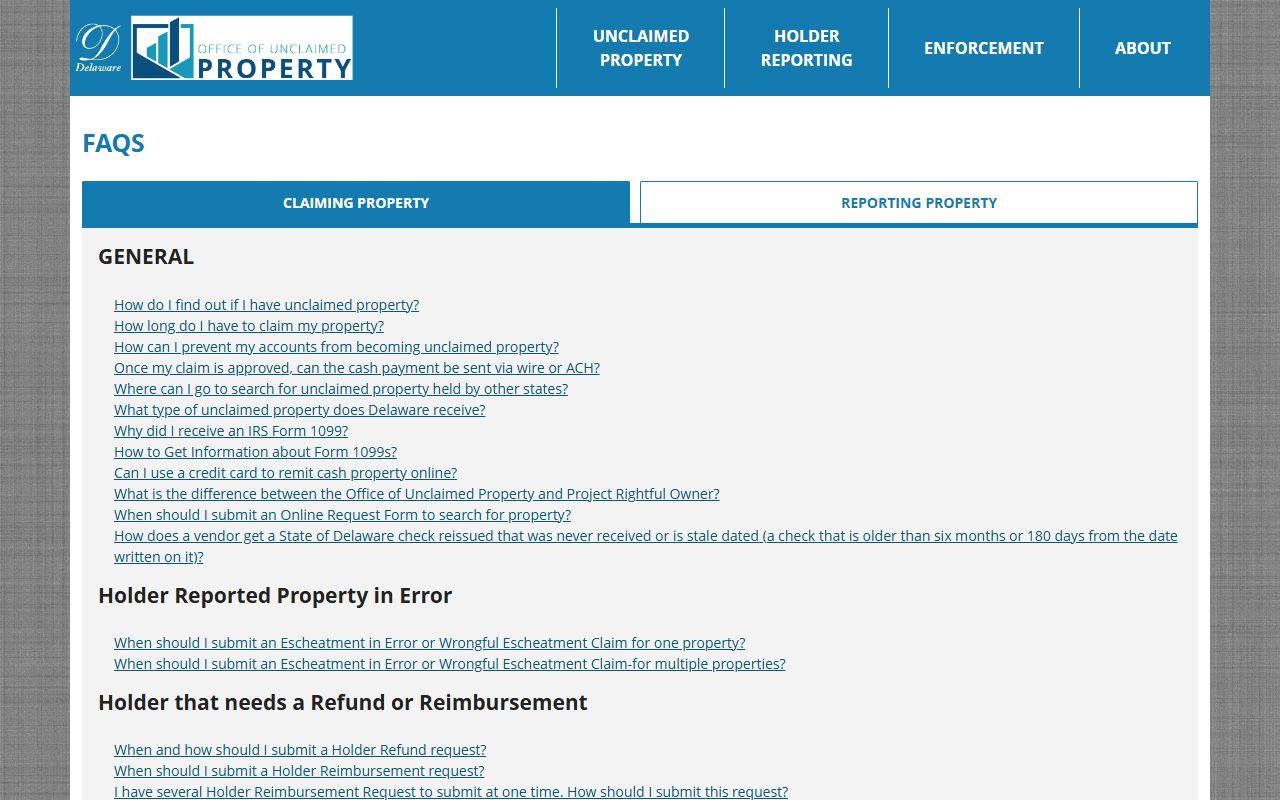
The FAQ also explains the Online Request Form process for property types like bonds and gift cards that do not appear in the standard search results, and what to expect in terms of timing after you submit a claim.
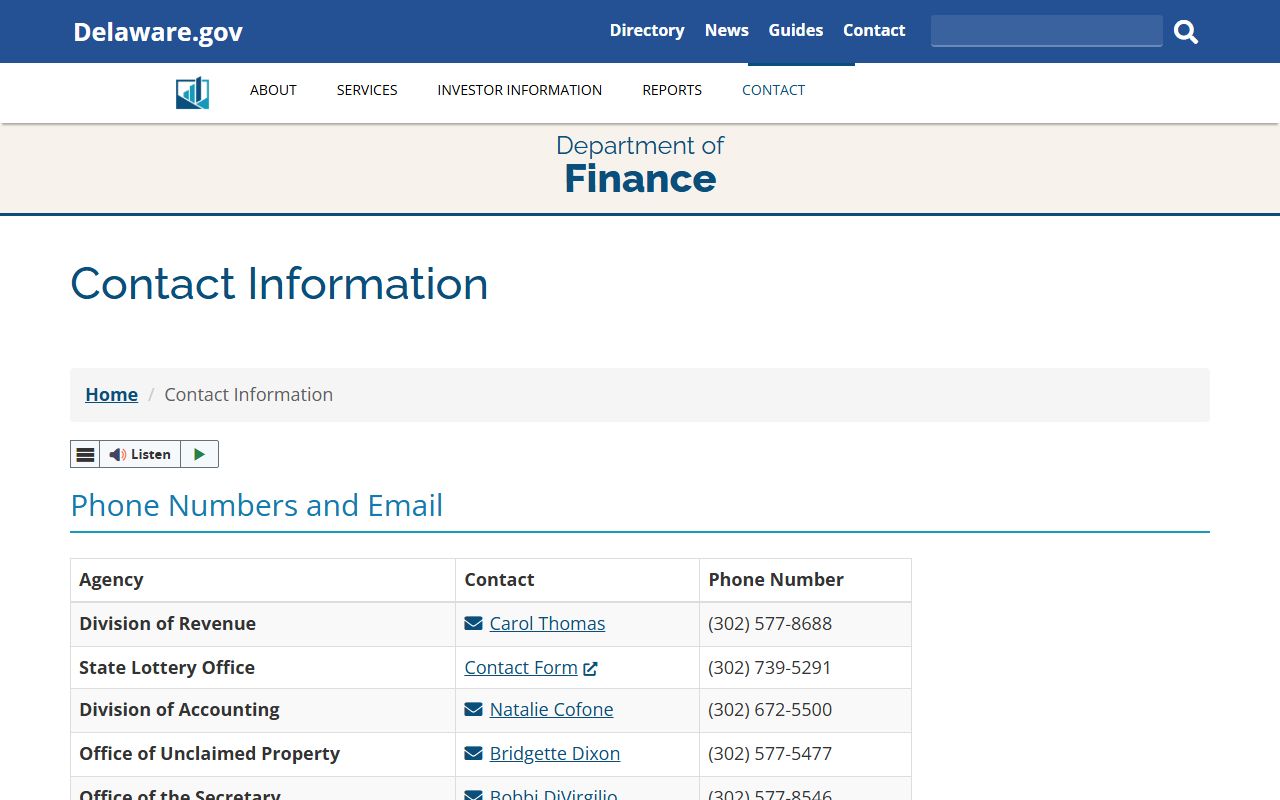
For direct assistance, contact the Office of Unclaimed Property at the Delaware Department of Finance. Bridgette Dixon handles inquiries at (302) 577-5477. The office is at 820 N. French Street, Wilmington, DE 19801. Media and press inquiries go to Bobbi DiVirgilio at (302) 577-8546.
The Delaware Department of Finance contact page lists staff for the Office of Unclaimed Property and related divisions, with direct phone numbers for claim assistance and a physical address for in-person visits.
If you have questions after submitting a claim, calling the office directly is often the fastest way to get a status update or learn what additional documents are needed to complete your file.
Delaware's MONEY MATCH Program
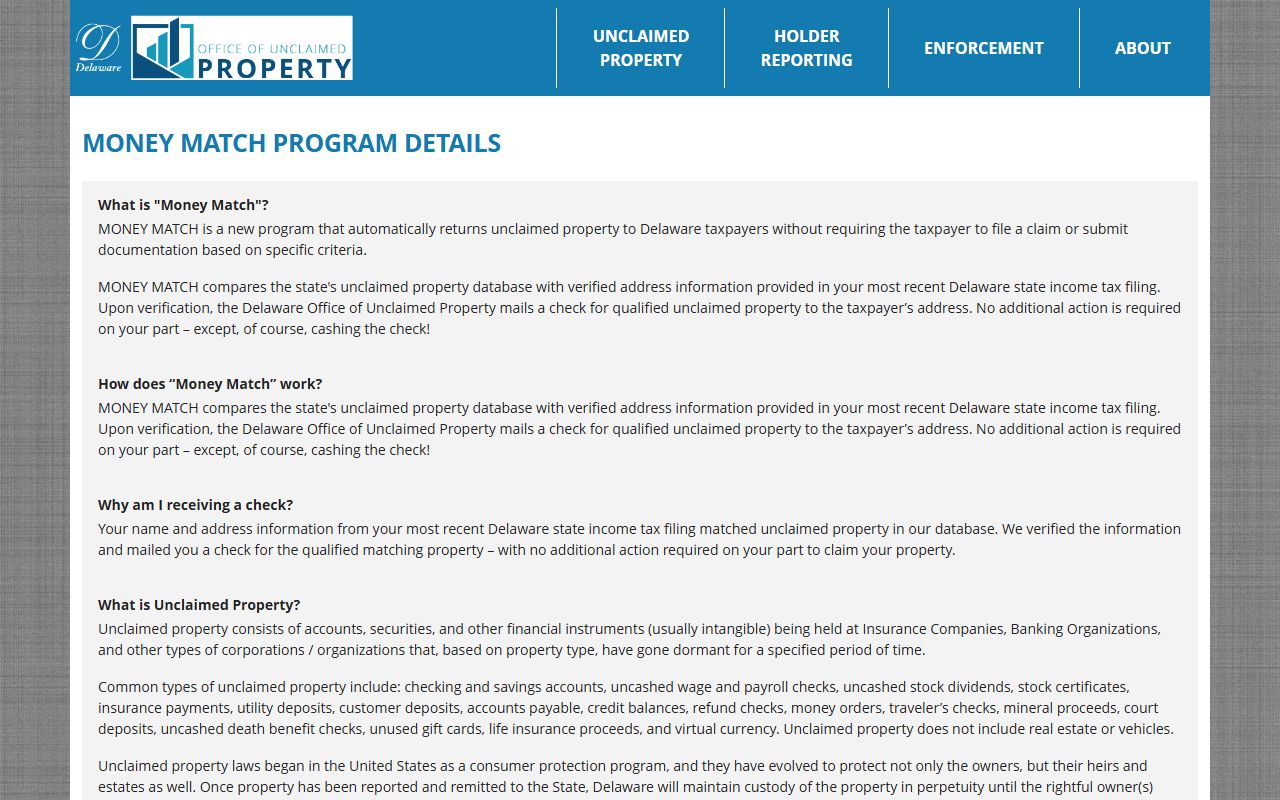
Delaware runs an annual program called MONEY MATCH that automatically returns unclaimed money to taxpayers without requiring a claim or paperwork. The program uses data from your most recent personal income tax return to match your identity against unclaimed property records. If a match is found, the state mails a check. You just cash it.
In September 2025, the program mailed approximately 2,800 checks and returned over $383,000 directly to Delaware taxpayers. That was the sixth round of MONEY MATCH. Since the program launched in 2021, it has returned over $5.6 million to almost 40,000 Delaware taxpayers. The program runs each September and expands its reach as matching improves.
Not every type of unclaimed property qualifies for the automatic match. If you do not receive a MONEY MATCH check but believe you have unclaimed money in Delaware, search the main database and file a standard claim. The program supplements but does not replace the regular process. If you file a state income tax return in Delaware and have property on file, keep an eye out each fall for a check from the Office of Unclaimed Property.
Delaware's MONEY MATCH program page describes how the automatic return program works, what property types are eligible, and how the data matching process connects taxpayer information to unclaimed money records held by the state.
The program is now in its sixth round and continues to grow. Delaware taxpayers who file state income tax returns and have matching unclaimed property on file are the most likely to benefit each September.
Project Rightful Owner: Sheriff's Sale Excess Proceeds
When a property is sold at a sheriff's sale in Delaware, the proceeds first pay off liens, mortgages, and fees. If the sale price is higher than what is owed, the leftover amount becomes excess proceeds. That money belongs to the former property owner. The Delaware Superior Court runs Project Rightful Owner to help former owners find and recover those funds.
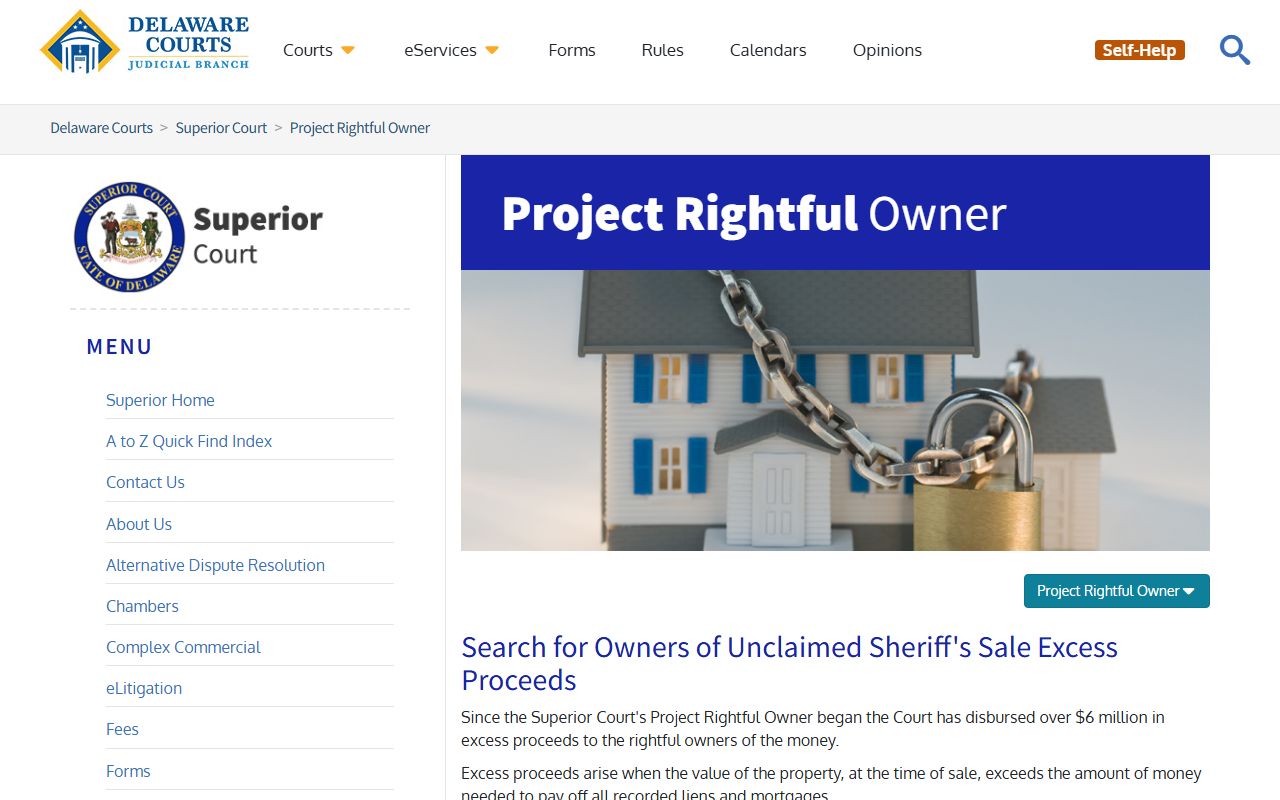
Project Rightful Owner is separate from the Office of Unclaimed Property. It handles only real property excess proceeds from sheriff's sales. Since the program began, the Superior Court has paid out over six million dollars. The court maintains lists for each county, organized alphabetically by the last name or business name of the person who owned the property at the time of sale. Those lists include the property address, the court-held amount, the sale date, and the case number.
Claiming excess proceeds can be a complex process. You need a title search dated within 60 days of your petition, a completed State of Delaware Substitute Form W-9, and certified copies of supporting documents. The filing fee is $75, waived for cases where proceeds are $1,000 or less. The court recommends working with an attorney. Free legal help is available through Delaware Volunteer Legal Services at 302-478-8680 or 1-888-225-0582. Unlike unclaimed property at the Office of Unclaimed Property, Project Rightful Owner pays interest from the date funds transfer to the Superior Court Prothonotary.
The Delaware Superior Court's Project Rightful Owner page maintains the official lists of excess proceeds from sheriff's sales in all three Delaware counties, with amounts, dates, and case numbers for each entry on the list.
Former property owners who had a sheriff's sale in New Castle, Kent, or Sussex County should check the county-specific lists to see if excess proceeds are being held. Cases from past years remain on the list until claimed.
Search Delaware and Other States at Once
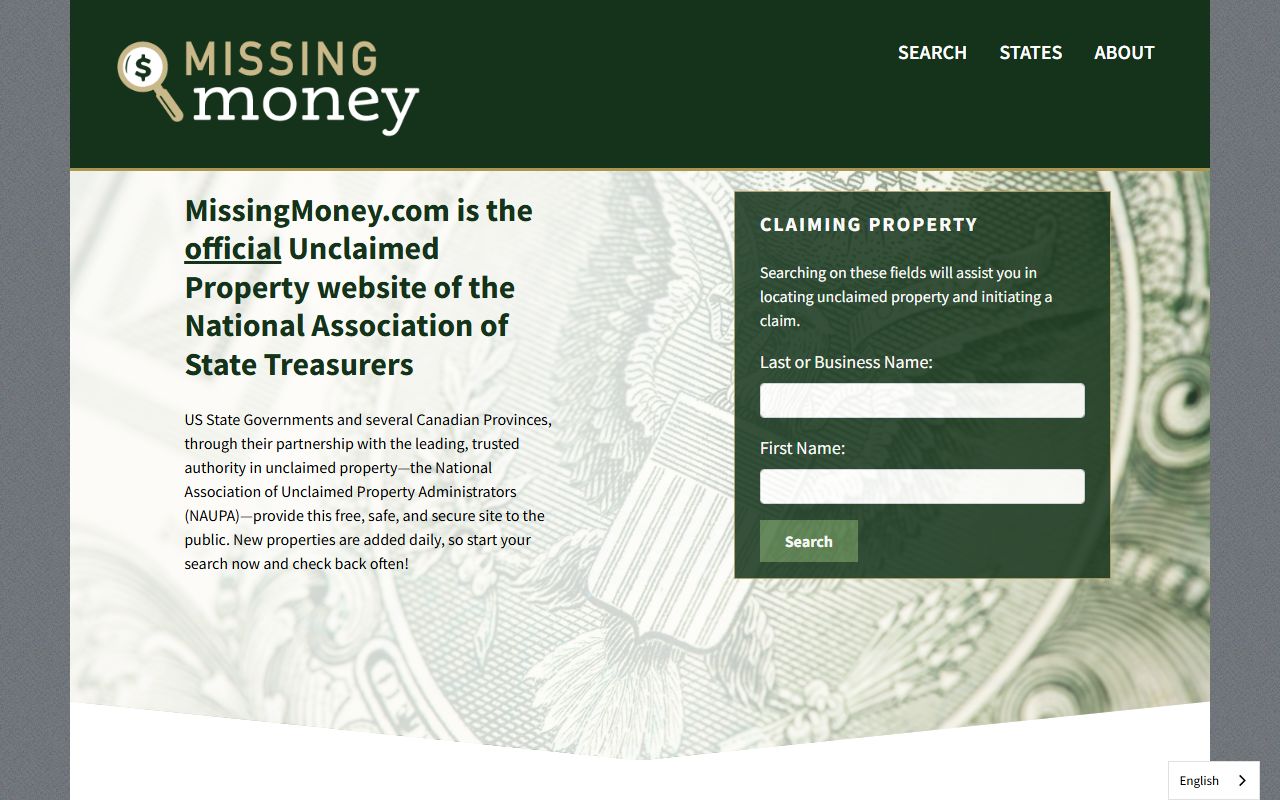
MissingMoney.com is a free multistate search portal sponsored by the National Association of Unclaimed Property Administrators, known as NAUPA. Delaware joined the coalition in October 2022. The site lets you run one search across nearly all states at the same time. This is useful when you have lived in multiple states or held accounts elsewhere and are not sure which state might be holding your funds.
Results from MissingMoney.com link back to each state's own claims process. If property turns up in Delaware, you still file through the Delaware Office of Unclaimed Property portal. The multistate search simply saves time by letting you cover many states in one pass rather than visiting each state site separately.
MissingMoney.com is the NAUPA-sponsored free portal where you can search unclaimed property records from Delaware and nearly every other U.S. state in one combined search, with results linked directly to the official state claims process for each state where property is found.
Delaware has been a participating member of the MissingMoney.com coalition since October 2022, meaning searches through that site now include the full Delaware unclaimed property database.
Unclaimed Funds in Delaware Bankruptcy Court
The U.S. Bankruptcy Court for the District of Delaware is one of the busiest in the country. It holds unclaimed funds from resolved cases that creditors or parties never collected. These funds are searchable through the federal courts portal at ucf.uscourts.gov.
To search Delaware-specific cases, go to the portal and select "DEB - Delaware Bankruptcy Court" from the dropdown. Enter a name or case number. If you find a match, file an Application for Payment of Unclaimed Funds in the format required by the court. A copy of the application must be served on the United States Attorney for the District of Delaware. Public computer terminals are available at 824 N. Market Street, 3rd Floor, Wilmington, Delaware 19801. You can also call the clerk's office at (302) 252-2900 to verify whether unclaimed funds exist in a specific case.
This source is entirely separate from the Delaware state unclaimed property program. Bankruptcy court funds come from federal proceedings, not from state-level dormant accounts. Creditors, former employees, and other parties to Delaware bankruptcy cases should check this resource in addition to the state portal.
The U.S. Bankruptcy Court unclaimed funds portal is the official search tool for locating money held from bankruptcy cases in the District of Delaware, with public access available both online and through in-person terminals at the Wilmington courthouse.
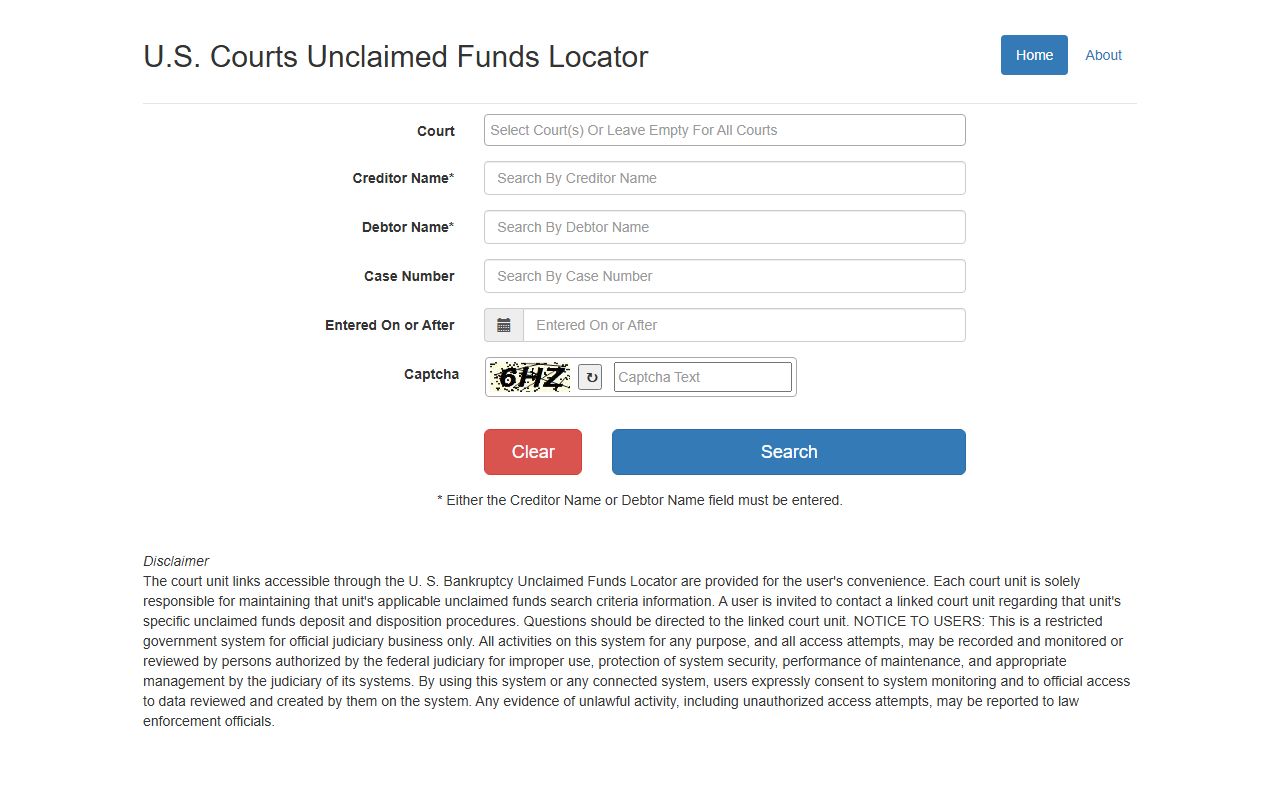
Given the volume of corporate bankruptcies filed in Delaware, this database may hold significant funds from cases involving well-known companies. It is worth checking even if the underlying case was years in the past.
Holder Reporting and Business Compliance
Delaware requires businesses and other holders to report and remit unclaimed property annually. Reports are due by March 1 for property with a December 31 report date from the prior year. The full value of the property must be reported. Service fees cannot be deducted. Delaware is a pay-to-current state under 12 Del. C. § 1135, meaning holders must remit the current value at the time of reporting.
Senate Bill 13, passed in 2017, established a compliance program under § 1170 of Title 12. This program strengthens Delaware's enforcement capability while creating a pathway for companies to come into compliance voluntarily. Before delivering securities to the state, holders must email their intent to Delaware's custodian five days in advance, with specific data that includes the issue name, CUSIP, ticker symbol, number of shares, and the delivering party's DTC participant information.
The Holder Reporting FAQ covers annual filing requirements, how to report different property types, wire and ACH instructions, and answers to questions from businesses holding Delaware residents' funds.
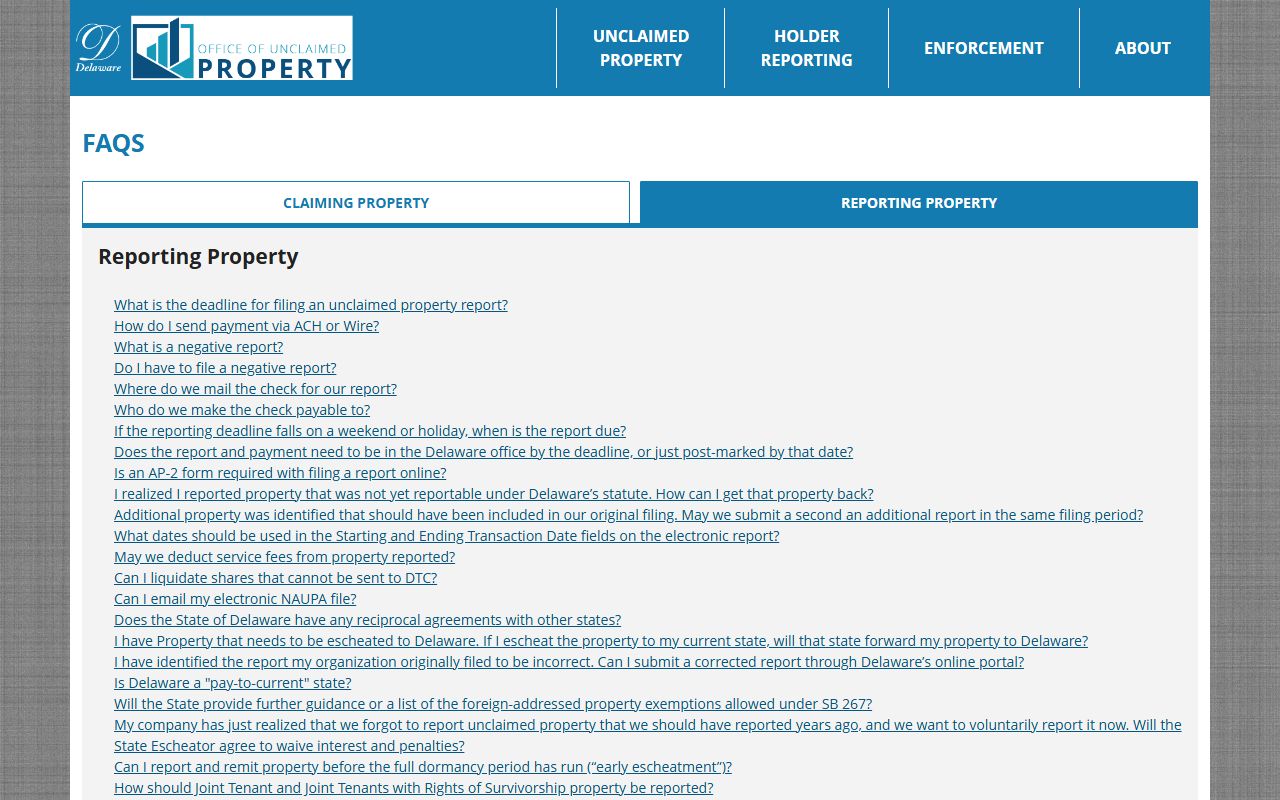
Holders can submit annual reports through the Delaware Office of Unclaimed Property website. The Holder Reporting Handbook provides full technical guidance including payment instructions for wire and ACH transfers.
Businesses that have not been reporting or need to resolve past obligations have an option through the Voluntary Disclosure Agreement program. The VDA program is run by the Delaware Secretary of State's office in coordination with the Department of Finance. Participating companies can receive statutory waivers of interest and penalties in exchange for coming into compliance on their own. Claims from property reported through the VDA follow the same process as any other claim through the Office of Unclaimed Property.
The Delaware Secretary of State's Voluntary Disclosure Agreement program gives businesses a formal path to bring unclaimed property reporting into compliance while reducing or eliminating penalties that might otherwise apply.
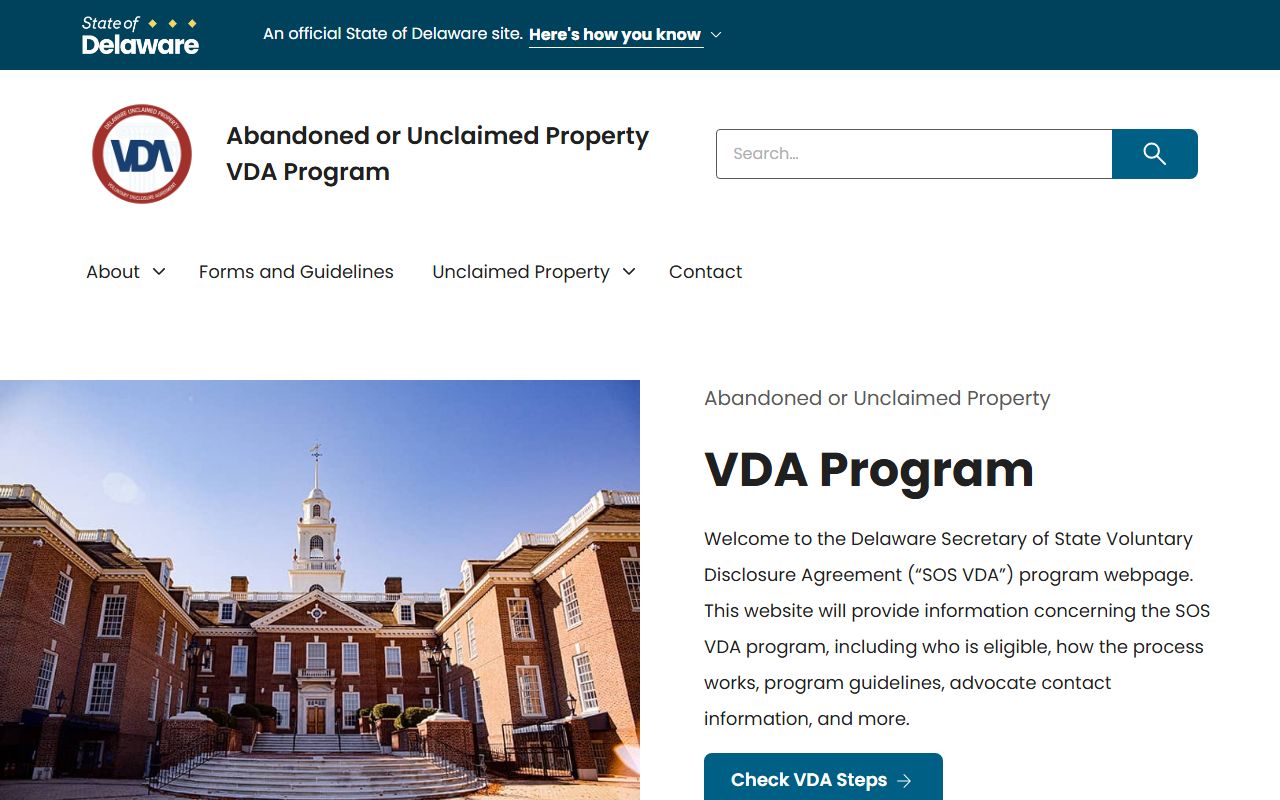
The VDA program is most relevant to companies incorporated in Delaware that have built-up unclaimed property obligations and want to resolve them before enforcement begins. Owner claims from property reported through the program are unaffected.
FOIA Requests and Public Records Access
The Delaware Department of Finance handles Freedom of Information Act requests for records related to unclaimed property and other finance matters. Requests can be submitted in writing through the state's central FOIA form, faxed to the FOIA Coordinator at 302-577-8982, or mailed to 820 N. French Street, Wilmington, DE 19801. In-person submissions are accepted at Delaware public service offices with "Attn: FOIA Coordinator" noted on the request.
Covered agencies under this process include the Department of Finance, Division of Accounting, State Lottery Office, Division of Revenue, and the Office of Unclaimed Property. Note that individual property values and claim details are not public records. State law restricts disclosure of property amounts and types to people who can prove a legal right to the property in question. General program data and operational records may be available through FOIA.
The Delaware Department of Finance FOIA page explains the process for submitting public records requests related to unclaimed property and other Department of Finance activities, with options for online, fax, mail, or in-person submission.
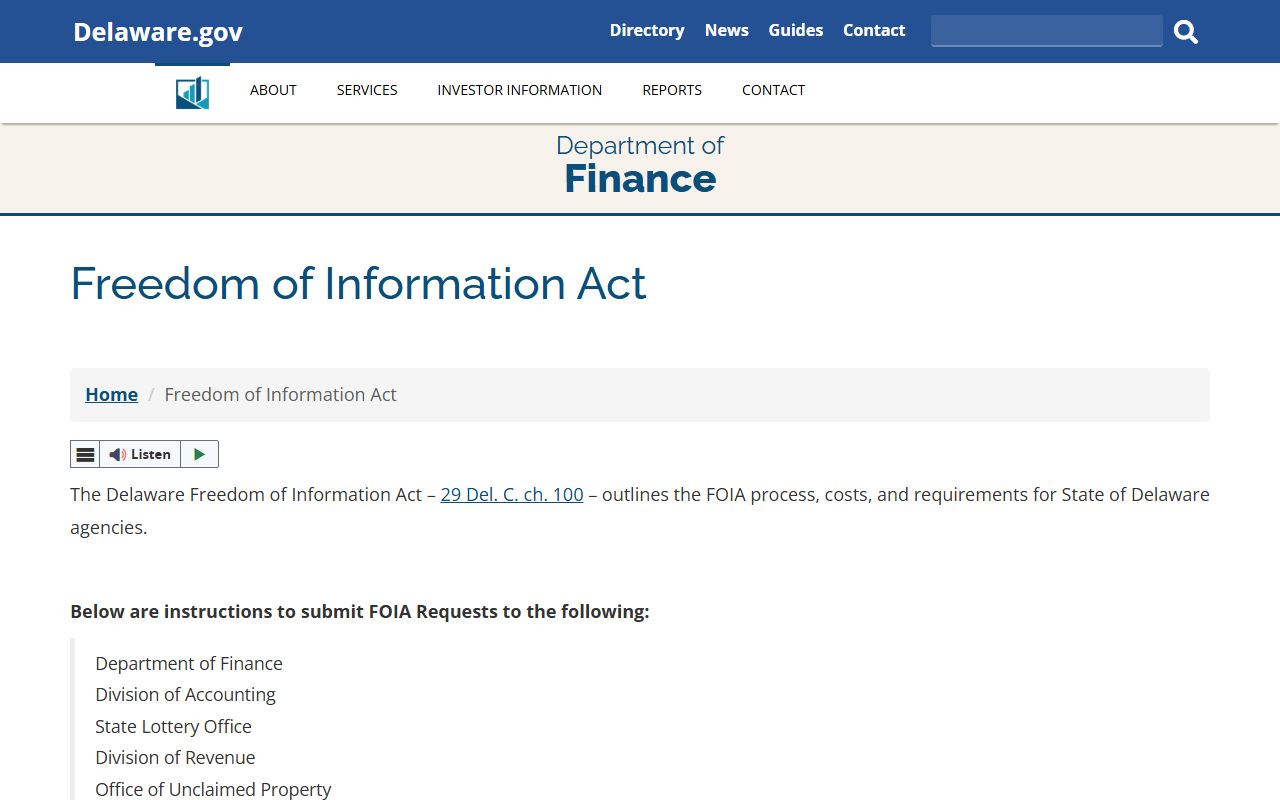
If you are researching the unclaimed property program itself or need operational records rather than individual claim information, FOIA provides the proper channel for making that kind of request to the Department of Finance.
Note: Individual property values and claim records are confidential under Delaware law and cannot be obtained through FOIA. Only program-level and operational records are available through that process.
Browse Delaware Unclaimed Money by County
Delaware has three counties. Each has its own set of local resources related to unclaimed money, including sheriff's sale excess proceeds, Register of Wills records, and county finance offices. Select a county to find local contacts and county-specific resources.
Unclaimed Money Resources by City
Major cities in Delaware each have local finance departments, police evidence units for found property, and connections to the state unclaimed money system. Select a city for local contacts and resources specific to that area.