
Find Unclaimed Money in Wilmington
Wilmington is Delaware's largest city and the county seat of New Castle County. Residents searching for unclaimed money in Wilmington use the same state portal as all Delaware residents, but several Wilmington-specific offices also play a role. The City Treasurer manages city financial accounts and disbursements, while the Citizen Self Service portal covers bills for utilities and property taxes. Wilmington is also home to the U.S. Bankruptcy Court for the District of Delaware, which holds unclaimed funds from resolved corporate bankruptcies. This page covers each resource and how to use it to find and claim unclaimed money connected to Wilmington.
Wilmington at a Glance
Delaware Unclaimed Money Search for Wilmington Residents
All unclaimed money searches for Wilmington residents start at unclaimedproperty.delaware.gov. The Delaware Office of Unclaimed Property holds dormant financial accounts from banks, insurance companies, employers, and other holders across New Castle County, including Wilmington. Searching is free. Claims can be filed at any time with no deadline and no fees.
Wilmington is home to the Delaware Department of Finance, which oversees the Office of Unclaimed Property. The office is located at 820 N. French Street, Wilmington, DE 19801. For direct assistance with unclaimed money questions, contact Bridgette Dixon at (302) 577-5477. The MONEY MATCH program, which runs each September, automatically returns funds to Delaware taxpayers without a formal claim when a data match is found between tax returns and unclaimed property records.
Because Wilmington is the largest city in the state and the base for many major financial institutions and corporations incorporated in Delaware, the state portal may hold funds from a wider range of sources for Wilmington-area residents than for residents of smaller cities. Former employers, banks, investment accounts, insurance policies, and utility deposits are all worth searching. Under Delaware Code § 1133, dormancy periods range from 3 years for securities to 15 years for traveler's checks. There is no interest paid on claimed property once it has been remitted to the state.
Wilmington City Treasurer's Office
The Wilmington City Treasurer is an independently elected office responsible for safeguarding the city's financial resources. DaWayne Sims currently serves as City Treasurer and can be reached at (302) 576-2480 or treasurer@wilmingtonde.gov. Deputy City Treasurer Alfred A. Lance, Jr. is at (302) 576-2482. The Treasurer's Office approves disbursements for operating, investing, and financing purposes through checks and electronic fund transfers including ACH. Vendor and payroll paper checks go out every Wednesday.
The Treasurer manages the city's deposit accounts at M&T Bank, which is the designated active depository of the City. The office also manages city investments, coordinates financing activity, and administers the city's pension benefits. The Treasurer serves on the city's Bond Committee as one of three voting members. City vendors with payment questions should contact the Finance Department at (302) 576-2487.
City of Wilmington financial transactions that go uncashed or uncollected can eventually become unclaimed property. Uncashed checks issued by the city to vendors, former employees, or residents would ultimately be reported to the Delaware Office of Unclaimed Property after the applicable dormancy period. The state portal is the right place to search for any such funds.
Citizen Self Service and City Bill Lookup
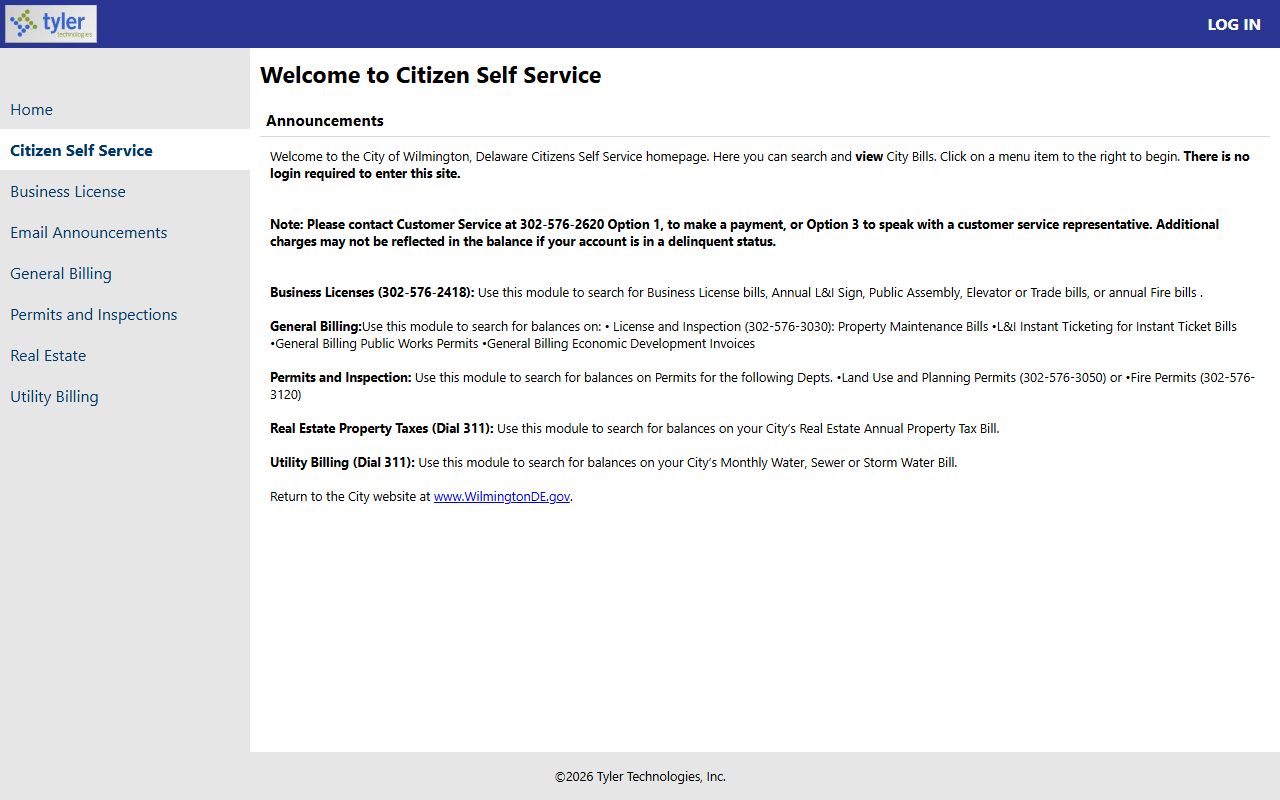
The City of Wilmington Citizen Self Service portal at cityofwilmingtondecitizens.munisselfservice.com/citizens/ allows residents and property owners to search and view city bills online. The portal covers business licenses, general billing for License and Inspection property maintenance bills, real estate property taxes, and utility billing for water, sewer, and stormwater charges.
Each billing type has a separate module and a separate contact number. For general payment questions, call (302) 576-2620 and select Option 1. To speak with a customer service representative, select Option 3. Business license inquiries go to (302) 576-2418. General billing questions go to (302) 576-3030. Real estate taxes and utility billing can be accessed by dialing 311.
Overpayments and credit balances on any of these accounts can become unclaimed property if the owner does not request a refund within the applicable time period. If you have moved or stopped using a Wilmington city service and believe a credit or deposit is owed to you, contact the relevant billing department first. If the city has already escheated those funds to the state, they will appear in the Delaware unclaimed property database.
The Wilmington Citizen Self Service portal provides online access to current and historical bill information for all city-managed accounts, including utilities, property taxes, and licensing fees that may carry credit balances.
If you have questions about a specific credit or deposit that is not visible in the portal, contact the relevant customer service line directly. Credits on city accounts that are not refunded within the dormancy period are required by law to be reported to the Delaware Office of Unclaimed Property.
Bankruptcy Court Unclaimed Funds in Wilmington
The U.S. Bankruptcy Court for the District of Delaware is located in Wilmington at 824 N. Market Street. It is one of the busiest bankruptcy courts in the United States, handling a large share of major corporate bankruptcy filings. When bankruptcy cases close and creditors, employees, or other parties do not collect what they are owed, those funds are held by the court as unclaimed. They can be searched through the federal courts portal at ucf.uscourts.gov.
To search Wilmington bankruptcy cases, select "DEB - Delaware Bankruptcy Court" from the dropdown menu on the portal. Enter the applicable search criteria, such as a name or case number. Public access computer terminals are available at the courthouse at 824 N. Market Street, 3rd Floor, Wilmington, Delaware 19801. The clerk's office can be reached at (302) 252-2900 to verify whether unclaimed funds exist in a specific case before you make the trip.
Claiming unclaimed bankruptcy court funds requires filing an Application for Payment of Unclaimed Funds in the format required by the court. A copy of the application must be served on the United States Attorney for the District of Delaware. This process is separate from the state-level unclaimed property program. If you were a creditor, former employee, or party to a Delaware bankruptcy case that closed without full distribution, checking this portal is worth your time.
New Castle County Resources
Wilmington is the county seat of New Castle County. County-level resources relevant to unclaimed money searches include the Recorder of Deeds, the Register of Wills, the Sheriff's Office for excess proceeds, and the Court Connect system for civil case records. Visit the New Castle County unclaimed money page for full details on all county-specific resources and contacts.
For excess proceeds from sheriff's sales in New Castle County, use the Delaware Superior Court's Project Rightful Owner list at courts.delaware.gov. Former property owners in Wilmington who had a property sold at a county sheriff's sale should check that list first before assuming no excess proceeds exist.